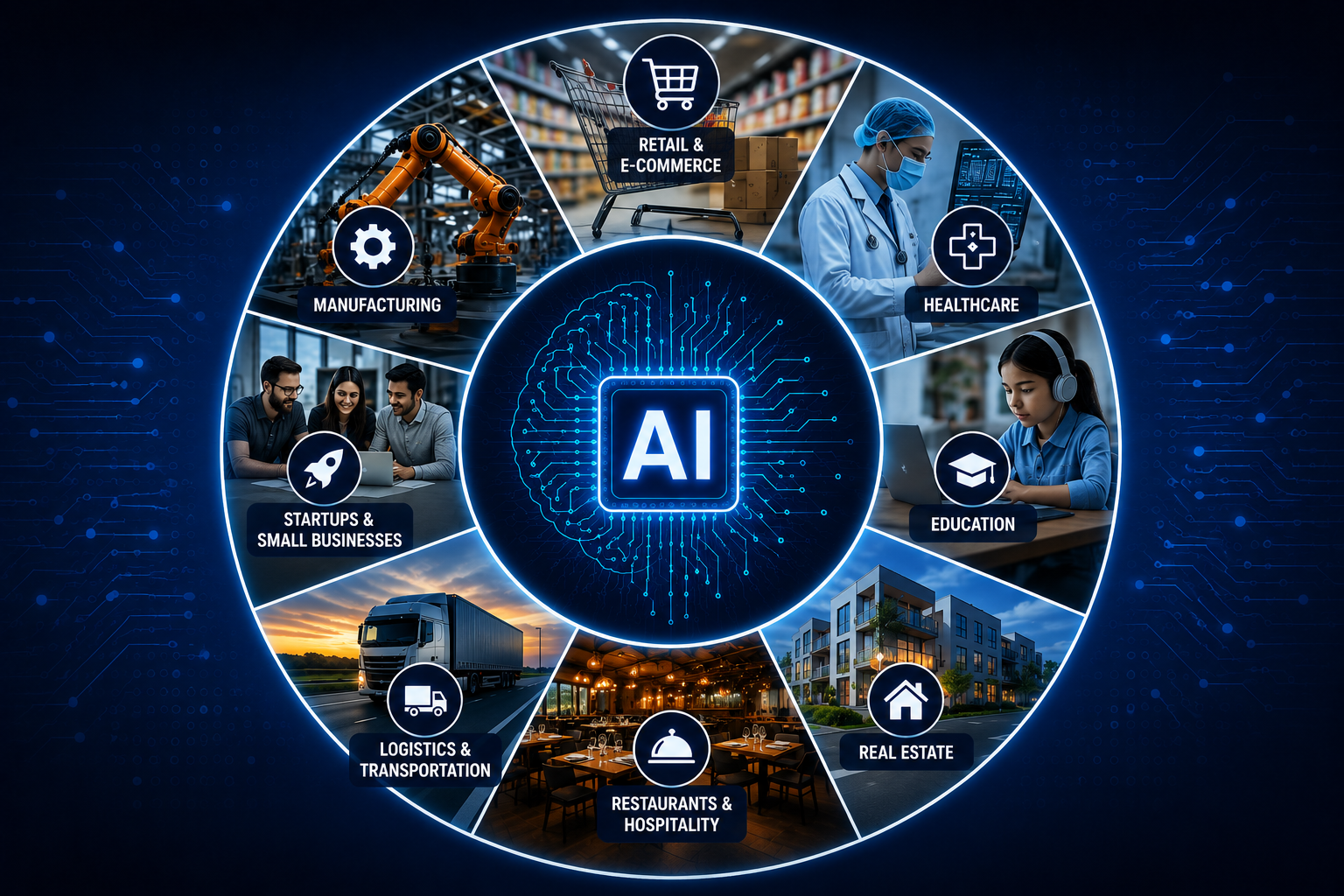
Artificial Intelligence (AI) is no longer limited to technology companies and large corporations. In 2026, businesses of every size and industry are leveraging AI to improve efficiency, reduce costs, enhance customer experiences, and make smarter decisions.
Whether you run a retail store, manufacturing unit, hospital, restaurant, logistics company, real estate agency, educational institution, or startup, AI can help you operate more effectively and stay competitive in an increasingly digital world.
What Is AI and Why Is It Important for Businesses?
Artificial Intelligence enables machines and software to perform tasks that typically require human intelligence. These include learning from data, recognizing patterns, making predictions, automating processes, and interacting with customers.
The biggest advantage of AI is simple: it helps businesses do more with fewer resources while improving accuracy and productivity.
AI in Retail and E-Commerce
Retail businesses are using AI to better understand customer behavior and optimize operations.
How AI Helps Retail Businesses:
- Smart inventory management
- Demand forecasting
- Personalized product recommendations
- Automated customer support
- Dynamic pricing strategies
This helps retailers reduce stock shortages, improve customer satisfaction, and increase sales.
AI in Manufacturing
Manufacturing companies are adopting AI to improve production efficiency and reduce downtime.
Common Applications:
- Predictive maintenance
- Quality control automation
- Supply chain optimization
- Production forecasting
- Equipment monitoring
AI helps manufacturers lower operational costs while improving product quality and output.
AI in Healthcare
Hospitals, clinics, and healthcare providers are increasingly using AI to improve patient care and administrative efficiency.
AI Benefits in Healthcare:
- Faster diagnosis support
- Appointment scheduling
- Patient record management
- Medical data analysis
- Virtual health assistants
This allows healthcare professionals to focus more on patient care and less on administrative tasks.
AI in Education
Educational institutions are using AI to create personalized learning experiences.
Examples Include:
- Smart learning platforms
- Automated assessments
- Student performance tracking
- AI-powered tutoring
- Administrative automation
AI helps educators identify learning gaps and improve student outcomes.
AI in Real Estate
Real estate businesses are leveraging AI to improve lead generation and customer engagement.
AI Applications:
- Property recommendations
- Market trend analysis
- Lead qualification
- Virtual property assistants
- Price prediction models
This helps agents and developers make better decisions and close deals faster.
AI in Restaurants and Hospitality
Hotels, restaurants, and hospitality businesses are using AI to improve customer service and operational efficiency.
Key Benefits:
- Automated reservations
- Customer feedback analysis
- Demand forecasting
- Personalized guest experiences
- Inventory management
AI helps businesses deliver better experiences while reducing waste and operational costs.
AI in Logistics and Transportation
Logistics companies rely on AI to optimize routes, reduce fuel costs, and improve delivery performance.
AI Solutions Include:
- Route optimization
- Fleet management
- Predictive maintenance
- Shipment tracking
- Demand forecasting
This leads to faster deliveries and improved customer satisfaction.
AI for Small Businesses and Startups
AI is becoming increasingly affordable, allowing startups and small businesses to access powerful tools once available only to large enterprises.
Popular Uses:
- Customer support chatbots
- Marketing automation
- Lead generation
- Sales forecasting
- Business analytics
- Content creation
These tools help small businesses compete more effectively without significantly increasing costs.
Benefits of AI for Every Business
Regardless of industry, AI offers several universal benefits:
Increased Productivity
Automates repetitive tasks and improves workflow efficiency.
Better Decision Making
Provides data-driven insights for smarter business strategies.
Reduced Operational Costs
Minimizes manual work and improves resource utilization.
Enhanced Customer Experience
Delivers personalized and faster customer interactions.
Improved Accuracy
Reduces human errors in business processes.
Scalability
Supports business growth without proportionally increasing costs.
Challenges Businesses Should Consider
While AI offers tremendous benefits, successful implementation requires:
- High-quality data
- Proper planning
- Employee training
- Data security measures
- Continuous monitoring
Businesses that approach AI strategically tend to achieve the best results.
The Future of AI in Business
AI is expected to become a standard part of business operations over the next decade. Organizations that adopt AI early will gain advantages in productivity, customer satisfaction, and profitability.
The question is no longer whether businesses should use AI—but how quickly they can integrate it into their operations.
Conclusion
Artificial Intelligence is transforming every industry, from retail and healthcare to manufacturing, education, logistics, and real estate. Businesses that embrace AI can improve efficiency, reduce costs, enhance customer experiences, and unlock new growth opportunities.
In 2026, AI is not just a technology trend—it is a powerful business tool that can help organizations of all sizes build a smarter, more competitive future.